Co²Skill: Whole-Body Control via Skill Composition for Long-Horizon Human-Environment Interaction
TL;DR One policy for a physics-simulated humanoid that composes whole-body scene interaction and dexterous manipulation, running skills sequentially or simultaneously.
Paper ↗ Method · Individual skills · Skill composition · Citation
The character picks up a wineglass and keeps it in hand through a sequence of scene interactions.
Everyday tasks mix moving through a scene with handling objects, like picking up a glass and then sitting down with it. Physics-based controllers usually learn these two separately. Co²Skill learns both in one policy.
Method
Sparse target goals
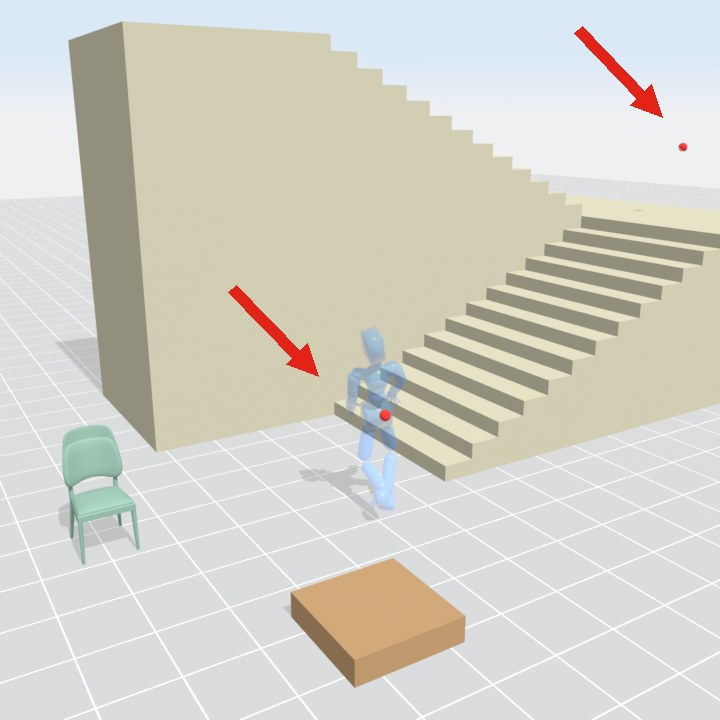
Every task is given as a sparse target goal, a few points marking where to interact, such as the top of the stairs or a seat. One policy reads the character, the nearby scene, and this goal, and outputs joint commands that run in physics simulation.
Stages 1–2: Motion prior
A whole-body tracking policy is trained on motion capture, then distilled into a motion prior and an action decoder.

Stage 3: Multi-task adaptation
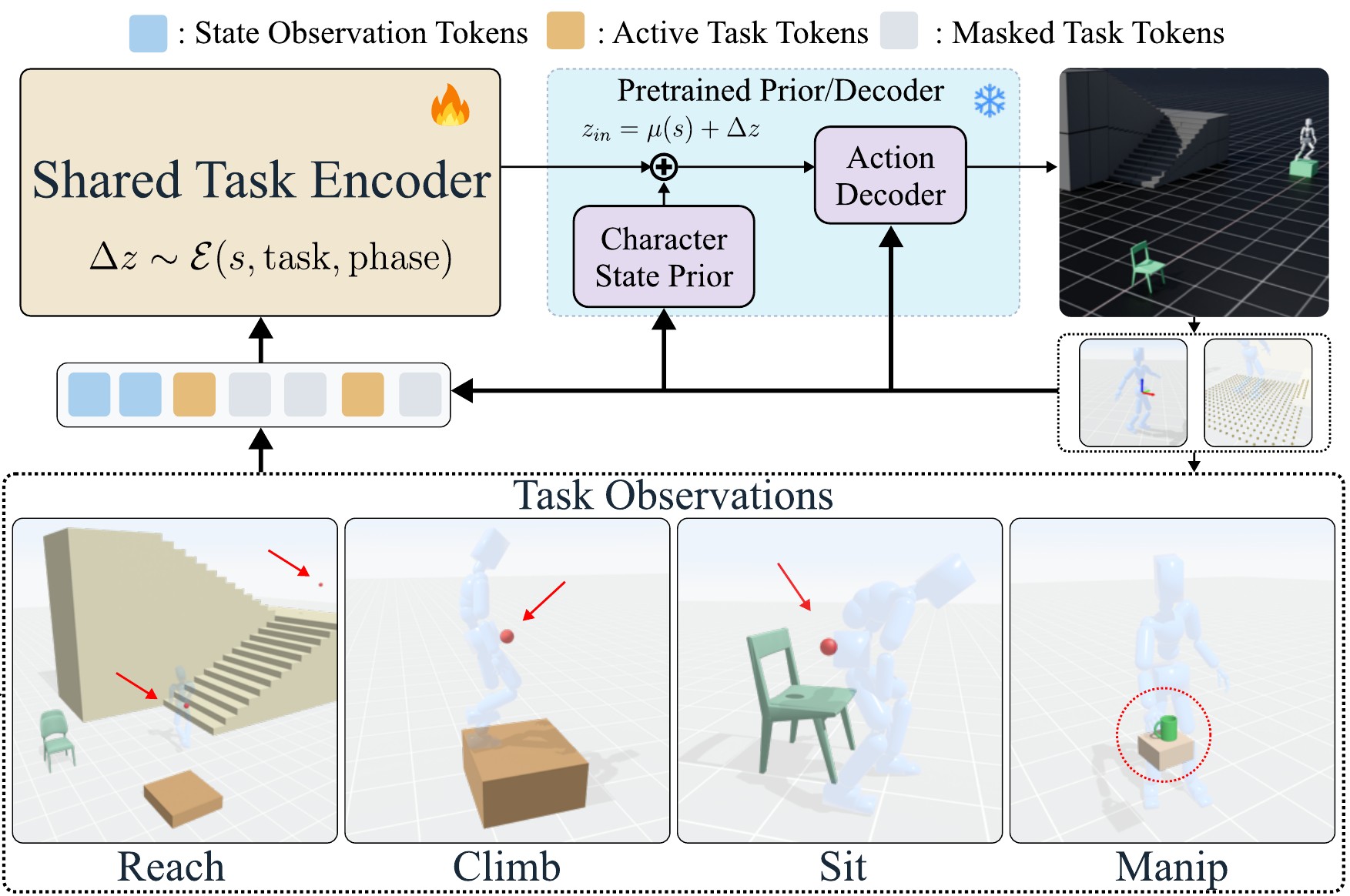
With the prior and decoder frozen, a shared task encoder reads the task observations and predicts a correction in the prior’s latent space.
Task-token masking
Masked task tokens turn on only the inputs the current task and phase need.
Reference-guided exploration
References guide close-range contact. Varied starts teach reaching the goal from new positions.
Reset-free chaining
Lift → sit, climb, or reach is trained without resets, so the grasp carries over.
Individual skills
Scene interaction
At test time the policy gets only a goal, such as a seat or the top of the stairs. No reference trajectory.
Sit on a chair
Climb the stairs
Manipulation
Given the object’s target pose and grasp conditions, the policy runs pick → move → place.
Cup
Water bottle
Mug
Camera
Skill composition
Sequential execution
Scene goals are issued one after another, without resetting the character.
Chair → platform → stairs
Simultaneous interaction
After the lift, a scene goal starts while the object stays in hand.
Carry upstairs
Hold and sit
Hold and climb
Citation
@misc{kim2026co2skill,
  title={Co${}^{2}$Skill: Whole-Body Control via Skill Composition for Long-Horizon Human-Environment Interaction},
  author={Jeonghwan Kim and Hyeonwoo Kim and Hanbyul Joo},
  year={2026},
  eprint={2610.09291},
  archivePrefix={arXiv},
  primaryClass={cs.RO},
  url={https://arxiv.org/abs/2610.09291},
}